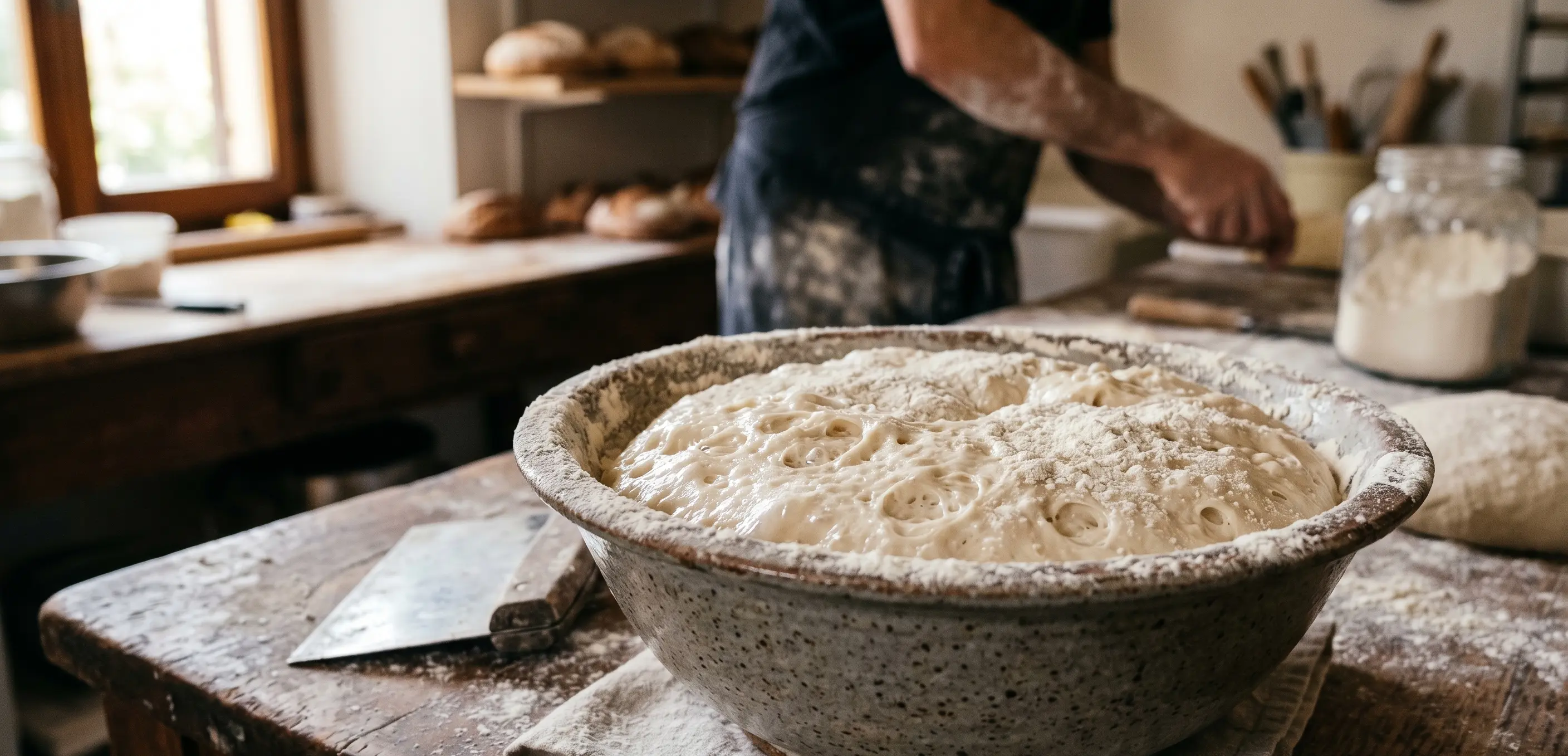
For nearly a decade, the dough race rewarded whoever pushed furthest. Hydration above 80%, 72 or 96-hour maturations, wild yeasts with complex aromatic profiles: every technical choice was also a positioning statement. The results were often outstanding, but hard to replicate consistently, sensitive to environmental variations, and dependent on precise daily management that not every operation can guarantee.
In 2026, the direction reverses. The most closely watched pizzaiolos and dough consultants are signalling a return to balance: hydration between 65% and 75%, long maturations within manageable timeframes, clean processes designed to be repeatable every day, every service, regardless of ambient humidity or staff availability.
Hydration: why 65-75% is back at the centre
An 80% hydration dough requires specific equipment, expert handling, and sensitivity developed over time. Replicating it consistently in a high-volume operation — where pizza is produced by multiple people across different shifts, with flours that vary batch to batch — is a real management challenge.
The 65-75% range offers a different trade-off: enough hydration for an open crumb structure and a light texture in the oven, without the error margins of a very wet dough. The crust rises, the base stays thin and crisp, digestibility does not suffer. This is not a downgrade — it is a professional operational choice.
Some new-generation flours, selected for strength and absorption capacity, amplify this effect: at the same stated hydration, dough behaviour is more stable and predictable, which lowers the learning curve for production staff.
Maturation: long but controlled
Long maturation remains a recognised value. A dough that rests 24-48 hours in a controlled cold room develops a more extended protein structure, better digestibility, and more complex flavour profiles than a same-day dough. This has not changed.
What changes in 2026 is the upper limit considered reasonable. The 72-96 hour maturations that had almost become a communication standard prove difficult to integrate into a continuous production cycle: they require cold room space, production planning three to four days in advance, and safety margins to handle unexpected demand peaks.
The new consensus converges on 24-36 hours at 4-6°C: sufficient for the enzymatic and proteolytic development that improves dough quality, compatible with daily operational management. Some operations adopt mixed protocols — part of the dough at 24 hours, part at 48 — to maintain production flexibility without sacrificing quality.
Replicability as professional value
The word that recurs in conversations with sector professionals is replicability. A dough that produces an outstanding result one time in three is not a competitive advantage: it is a source of inconsistency perceived by the customer.
Replicability depends on three variables: ingredient quality, precision of processing, and consistency of the baking process. The first two can be controlled with standardised procedures. The third depends on the oven.
The oven as the closing variable
A balanced dough, carefully processed and correctly matured, arrives in the baking chamber with a precise potential. The oven can realise it — or squander part of that work.
The critical variables are deck temperature and dome temperature, and their relationship. A deck at 350-380°C transfers heat through direct conduction to the base, triggering the Maillard reaction in the lower crust within the first seconds of baking. An adequately hot dome manages the baking of toppings and crust rim through radiant heat. If the deck is cold or the dome too low, the dough cannot express the structure that maturation has built.
Hand-crafted refractory brick decks — like those in Ceky ovens, built in Lograto since 1935 with 60 mm hand-worked bricks — accumulate heat with high thermal inertia and release it gradually between one bake and the next. In a high-volume service, where the deck is loaded dozens of times per hour, this characteristic determines baking consistency more than any other single parameter.
The balanced doughs of 2026 do not require a new oven. They require an oven that works as it should: stable temperature, rapid thermal recovery, predictable heat management. The best dough technique in the world does not compensate for an oven operating outside its thermal window.