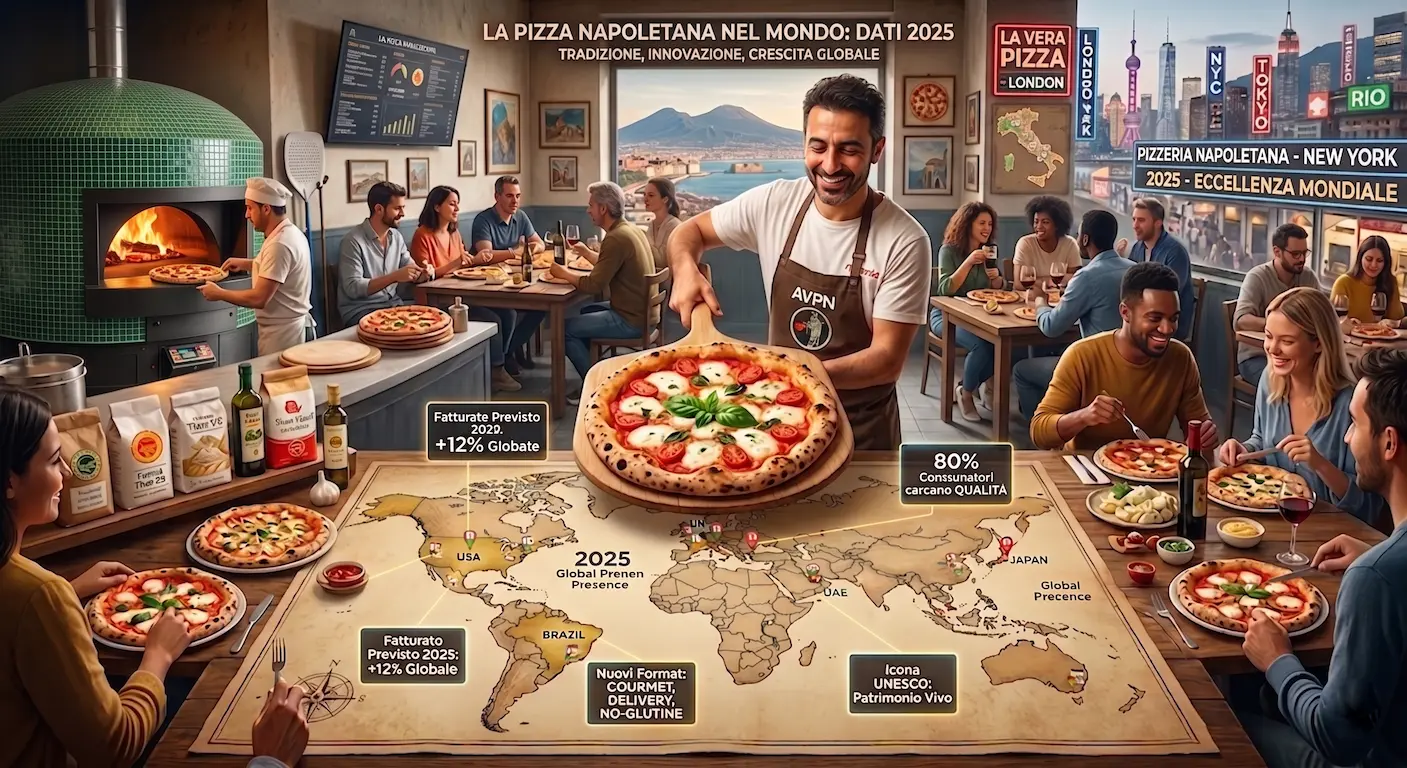
Neapolitan pizza has crossed Italian borders for decades, but 2025 marks a moment of unprecedented acceleration. Mature markets like the United States and Japan continue to grow, while new markets in the Middle East, South-East Asia and Latin America are maturing rapidly. For professional oven manufacturers, these data points are not just statistics — they are indicators of where the next pizzerias will open.
The role of AVPN and STG certification
The Associazione Verace Pizza Napoletana, founded in Naples in 1984, has built an internationally recognised certification system over time. The STG mark (Traditional Speciality Guaranteed), obtained at European level in 2010, gave Neapolitan pizza a regulatory status comparable to other Italian DOP and IGP products.
This recognition has had a direct effect on how the product is perceived in international markets. More and more pizzerias, even outside Italy, are seeking AVPN certification to stand out in crowded markets. And AVPN certification requires specific ovens, built to precise technical parameters.
Key markets in 2025
United States: the largest international market for authentic-style Neapolitan pizza. Coastal cities — New York, Los Angeles, Miami, Chicago — have seen a proliferation of Neapolitan pizzerias over the past ten years. The trend is now spreading to smaller urban centres, where the "artisanal and authentic" positioning works well with a clientele willing to pay more for certified quality.
Japan: traditionally one of the most quality-conscious food markets in the world, Japan has developed a deep and autonomous culture of Neapolitan pizza. Some of the most technically refined Neapolitan pizzerias in the world are in Tokyo and Osaka. Respect for raw ingredients and technical precision in service make the Japanese market particularly receptive to high-end ovens.
Middle East: Dubai, Abu Dhabi and Riyadh are investing in quality dining at an accelerated pace. Neapolitan pizza, with its premium positioning and recognisable cultural identity, fits well in the luxury hospitality segment that characterises these markets.
Northern Europe: Germany, the Netherlands, Scandinavia and the UK show sustained growth. Structural demand for authentic Italian products in these markets is high, and Neapolitan pizza is taking market share from Roman-style and American-style pizza.
The social media factor
One of the least discussed drivers of this growth is social media visibility. Neapolitan pizza is one of the most filmed and shared subjects in food content: the crust puffing up, the flame in the wood-fired oven, the steam rising at the cut. These images perform better on Instagram and TikTok than almost any other food product.
This visibility has a direct effect on demand: consumers who discover Neapolitan pizza on social media then actively seek it out in restaurants. And pizzaiolos who invest in photogenic equipment — wood-fired ovens, artisanal settings — gain a visibility return that cannot be measured in covers alone.
What this means for anyone opening a pizzeria today
The global growth of Neapolitan pizza creates concrete opportunities for those looking to open or reposition a pizzeria. The "authentic Neapolitan" segment offers higher margins than traditional pizza, more loyal customers, and greater differentiation potential in saturated markets.
But authenticity must be demonstrated. The oven — its origin, its materials, its certification — is often the first element communicated to customers, both in the venue and on digital channels. A Ceky oven AVPN-certified, built in Lograto since 1935 with a hand-laid 60 mm refractory brick deck, is not just a cooking tool: it is part of the story a pizzeria tells.
We are present in more than 60 countries. If you are considering opening or expanding, our technical team is available for a direct consultation.