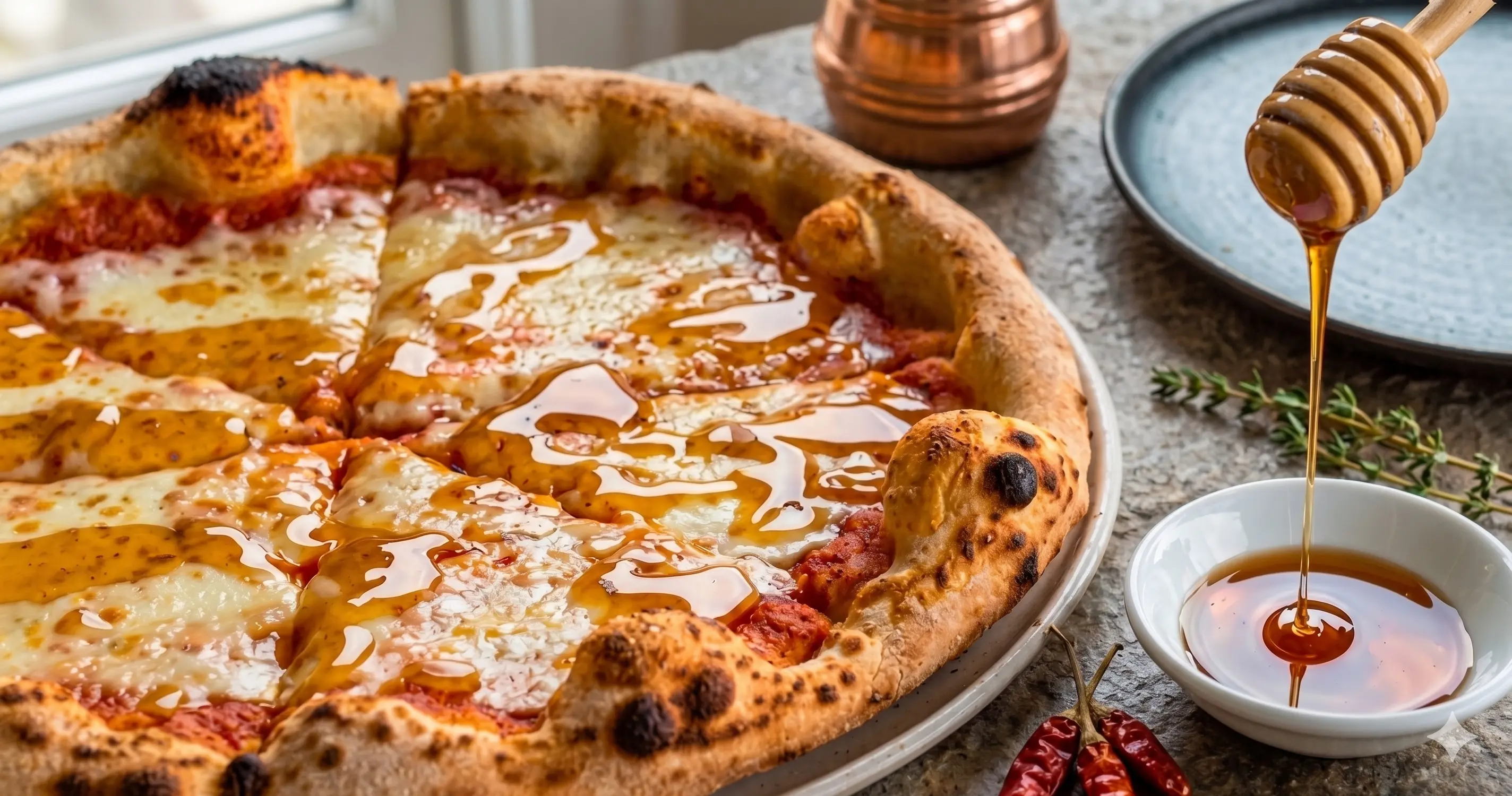
Hot honey — the now-common name across the entire food industry — is not a marketing invention. It is the result of a precise gastronomic logic: the sweet-spicy contrast works because it activates different receptors in rapid sequence, generating a more intense sensory response than any single flavour. On a pizza just pulled from a wood-fired oven at 430°C, this effect is amplified.
The phenomenon started on the American East Coast in the early 2010s, went mainstream during Covid — when demand for bold flavours was high and home kitchens became laboratories — and by 2026 is firmly established on menus in pizzerias across Europe, Japan and the Middle East.
Why the sweet-spicy contrast works on pizza
Pizza is a balanced system: fermented carbohydrates, fat (mozzarella, oil), acid (tomato), salt (anchovies, olives). Honey adds a note of sweetness that breaks the linearity of the flavour profile. The chilli — typically Calabrian or dried chilli in hot honey — adds capsaicin, which stimulates TRPV1 thermal receptors independently of the actual heat of the pizza.
The result is a layered perception: heat from the oven, spice from the capsaicin, sweetness from the honey, salt from the mozzarella. Intensity built from distinct layers, not a single dominant flavour.
Post-bake, not pre-bake
Hot honey is almost always added after baking, not before. The reason is technical: above 120°C, fructose in honey burns rapidly, producing bitterness. At 420°C — the standard deck temperature of a Ceky oven in service — honey would carbonise in seconds.
The correct application is on the rim of the plate or drizzled on the pizza immediately after it comes out of the oven, using a kitchen squeeze bottle or a spoon. The optimal amount is 10–15 ml per 33 cm pizza: enough to be present in every bite, without masking the flavour of the base.
Some variants apply the honey mid-bake (30–45 seconds before pulling the pizza) to achieve a controlled caramelisation. A viable technique, but one that requires precision: it depends on the actual dome temperature at that moment.
Pairings that work
Hot honey does not work on everything. The most effective vertical contrasts are:
- Spicy + fatty: ricotta, stracchino, mild gorgonzola — sweetness and heat balance the density of the cheese
- Spicy + intense salt: speck, salame piccante, anchovies — the sweetness softens the aggressive salinity
- Spicy + bitter: rocket, radicchio, escarole — the honey balances the tannins of the greens
It works less well on pizzas that already have a sweet profile (cherry tomatoes, figs, balsamic reduction): the result is an excess of sugar that flattens rather than contrasts.
What you need to do it well
Technically, hot honey requires no changes to the baking process: it is made or purchased separately and applied at the pass or tableside. What changes is the setup of the base pizza: a well-developed cornicione with the right alveolar structure holds a liquid addition better without going soggy. A bake at the correct temperature — deck at 400–420°C, time 60–90 seconds — produces exactly this result.